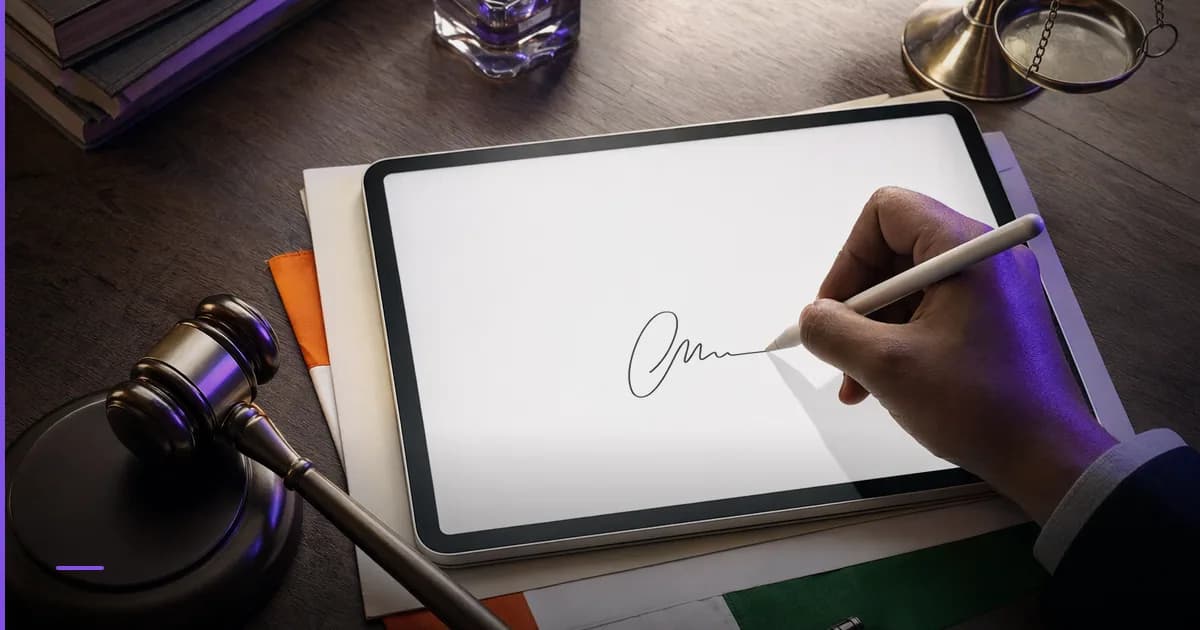
Short answer: yes. Electronic signatures have been legally recognized in India since the Information Technology Act, 2000. Indian businesses sign commercial contracts, offer letters, NDAs, vendor agreements, and invoices electronically every day, and courts accept electronic records as evidence.
The longer answer has real nuance — a few document types still require wet ink, and not every "signature image pasted on a PDF" carries the same weight. This guide covers what matters in practice. (This is general information, not legal advice — consult a lawyer for your specific situation.)
The legal foundation
Three pieces of Indian law do the heavy lifting:
- Information Technology Act, 2000 — grants legal recognition to electronic records and electronic signatures. Section 5 gives a valid electronic signature the same standing as a handwritten one where the law requires a signature.
- Indian Evidence rules for electronic records — electronic records are admissible as evidence, which is what makes electronically signed agreements enforceable in dispute.
- Indian Contract Act, 1872 — the fundamentals of a valid contract (offer, acceptance, consideration, capacity) don't care about the medium. If those elements exist, a contract formed electronically is a contract.
What makes an electronic signature reliable
Indian law recognizes signatures that are linked to the signer, capable of identifying them, and applied in a way where any later change to the document is detectable. In practice, reliability comes from evidence:
- Signer authentication — who signed (verified email, OTP, or Aadhaar-based eSign)
- Intent and consent — a clear action showing the person meant to sign
- Audit trail — a timestamped record of who did what, when, and from where
- Tamper evidence — proof the document wasn't altered after signing
A signature image dropped onto a PDF in an editor has none of this. A signature applied through a proper eSignature platform carries all of it — and that difference is exactly what matters if an agreement is ever challenged.
Documents you still can't sign electronically
Indian law excludes certain instruments from electronic execution. The commonly cited exclusions include:
- Negotiable instruments such as promissory notes and bills of exchange (other than cheques)
- Powers of attorney
- Trusts (creation documents)
- Wills and other testamentary dispositions
- Contracts for the sale or conveyance of immovable property, or any interest in such property
For everything else — commercial contracts, employment paperwork, NDAs, service agreements, procurement, client onboarding — electronic signing is standard, legal practice.
What this means for your business
If your agreements are still printed, signed, scanned, and emailed, you're spending days on something that takes minutes, and ironically ending up with weaker evidence than a proper electronic workflow produces — no verified identity, no audit trail, no tamper protection.
A modern eSignature workflow gives you legal validity and operational speed: agreements go out, get signed in the right order, and come back tracked, sealed, and audit-ready.
Frequently asked questions
Is a scanned image of my signature legally valid in India? It may show intent, but it's weak evidence — there's no authentication, no audit trail, and no tamper protection. A proper electronic signature workflow is significantly more defensible.
Are electronically signed contracts admissible in Indian courts? Yes. Electronic records are admissible as evidence under Indian law, and the audit trail from a reliable signing platform strengthens the case considerably.
Can I sign agreements with foreign companies electronically? Generally yes — most major economies (the US under the ESIGN Act, the EU under eIDAS) recognize electronic signatures, making cross-border electronic contracting routine. Check the counterparty's local requirements for special document types.
Do employment offer letters qualify? Yes. Offer letters, appointment letters, NDAs, and policy acknowledgements are among the most common electronically signed documents in India.
Ready to move your agreements from inbox limbo to signed-in-minutes? ZiaSign — Zettaura's AI contract intelligence and eSignature platform — handles sending, signing, tracking, and understanding your agreements in one secure workflow.